


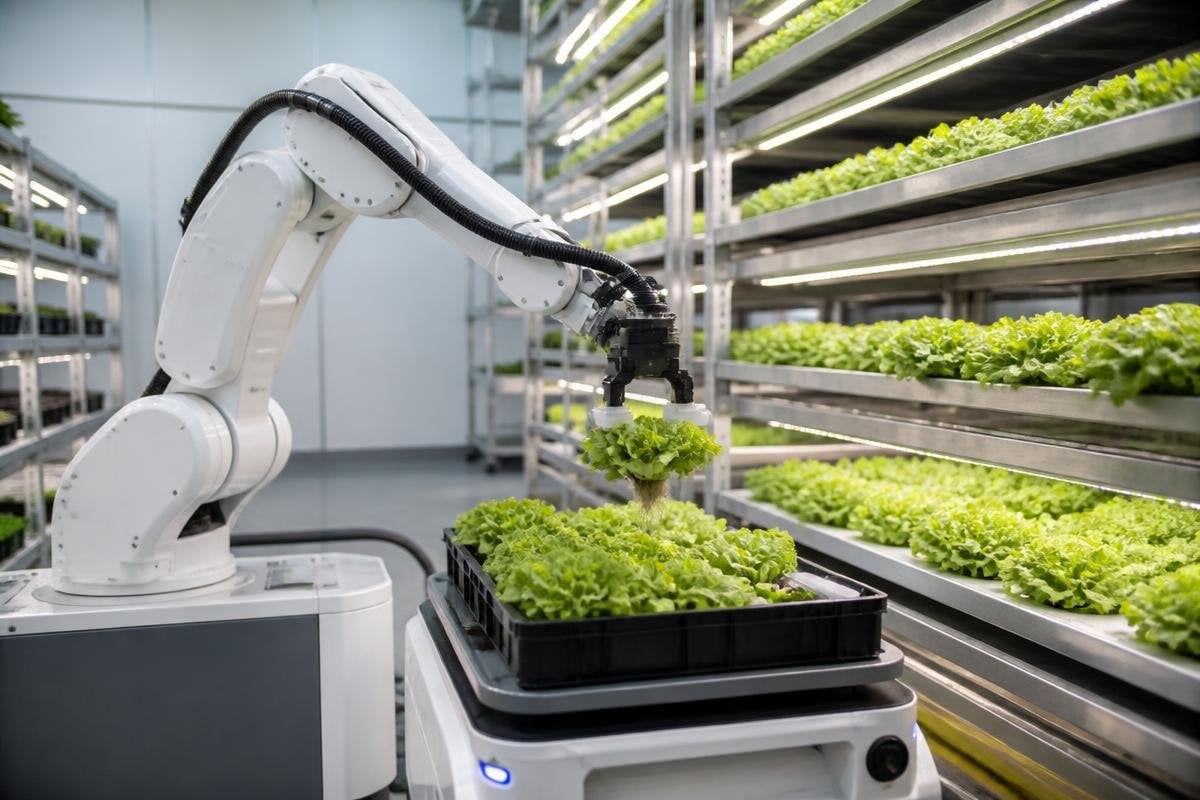
A robot can pick lettuce, move trays, or check plant health, but it cannot fix a farm that spends too much on electricity. Indoor farming becomes profitable only when automation cuts labor and crop losses by more than the added cost of robots, sensors, software, lighting, and climate control.
Quick read
- Automation works best on repeat tasks with fixed routes and steady crop layouts.
- Electricity, labor, crop price, and robot uptime decide the farm’s result.
- A small pilot should prove the savings before a full build-out.
Where robots can lower costs
Indoor farms repeat the same work across many racks.
Trays need to move between seeding and growing areas, plants need checks, and crops need to reach a packing line. Those jobs suit mobile robots, robotic arms, conveyor systems, and machine vision.
Machine vision uses cameras and software to inspect plants. It can flag missing seedlings, uneven growth, or leaves that show a problem. A worker still needs to decide what to do, but the inspection starts with a smaller group of plants.
That matters when the farm has more growing levels than a person can check quickly. The same system can move trays while workers focus on seeding, crop care, and packing. The saving comes from fewer labor hours per tray, not from owning a robot.
The layout matters just as much. Long routes between racks waste battery power and staff time. A farm needs clear paths, repeatable tray positions, safe handoff points, and software that can report a failed task.
The costs that can erase the saving
Indoor farms already pay for lights, pumps, fans, heating, cooling, water treatment, buildings, and staff. Robots add purchase costs, charging equipment, software fees, repairs, safety checks, and time for workers to learn the system.
Power deserves the first spreadsheet line. LEDs run for the crop cycle, while climate equipment may run through every hour of the day. If automation raises output but the farm still pays too much to grow each kilogram, the robot has not fixed the business.
Crop choice also sets the limit. A robot may handle leafy greens in standard trays more easily than crops with uneven shapes, fragile stems, or different harvest sizes. The task must stay repeatable long enough for the machine to recover its cost.
Robot uptime matters in the same way. A machine that works during a demonstration but stops during harvest creates extra work. Staff must move trays by hand, find the fault, and keep the crop on schedule.
What a useful pilot should measure
A farm manager should test one task before buying a full robot fleet. The test needs a clear starting point, a fixed crop area, and records from both manual and automated work.
One successful tray run won’t tell a farm manager whether a robot pays for itself. A dated report from Robot24 can add a named machine, crop task, and stated limit for comparison with your own trial. Keep that comparison close to the cost record, because handling one tray well may leave the full shift unchanged.
Track the cost of each tray through the task. Record labor minutes, failed moves, crop damage, battery charging, repair time, and the amount of work completed per shift. These figures tell you more than a robot’s top speed.
The pilot should also test bad days. Check what happens when a tray is out of place, a camera gets dirty, a network link drops, or a motor stops. A system that needs a specialist for every small fault may cost more to run than the labor it replaces.
A buying checklist for indoor farms
Use these checks before signing a robot order:
- Name the task: Pick tray movement, inspection, harvesting, or packing rather than buying a general system.
- Count labor minutes: Measure the current time per tray and the time with the robot running.
- Price the full system: Add software, charging, repairs, safety equipment, and training to the purchase cost.
- Check plant fit: Confirm that the gripper, camera, and tray system suit the crop at each growth stage.
- Test failure recovery: Ask staff to restart a stopped robot without waiting for the supplier.
- Set a payback limit: Choose the maximum time the farm can wait before the system must cover its cost.
The decision comes down to proof
Robots can improve the numbers in a controlled indoor farm, especially where trays follow the same route and workers repeat the same movements. They cannot make expensive power, weak crop prices, or poor layouts disappear.
I’d wait for measured savings from a small pilot before buying a large system. The farm should expand automation only after the records show lower cost per crop unit, steady robot uptime, and a clear payback period.
