


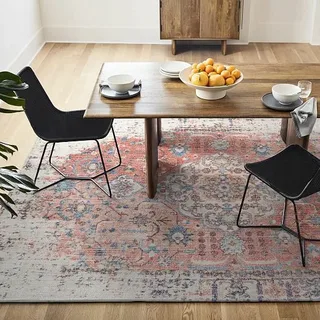
You sit down for a meal. You slide your chair in. The rug bunches up under the back legs. You stand up to get water, push the chair back, and the rug ripples again. It’s a small annoyance, but over time, it becomes a major headache.
Dining rooms are unique spaces. In a living room, furniture stays put. In a dining room, furniture moves constantly. Every meal involves sliding heavy wooden or metal legs across the floor. This friction creates specific demands for your floor covering. A delicate, high-pile carpet might look stunning in a showroom, but it will fail quickly under the daily grind of breakfast, lunch, and dinner.
Selecting the right rug requires a strategic approach. You need durability without sacrificing style. You need a surface that allows chairs to glide effortlessly while anchoring the room visually. This guide breaks down exactly how to find dining room rugs that stand up to the challenge.
Why Chair Movement destroys rugs
We often underestimate the physical stress we put on our floors during a meal. A chair doesn’t just sit there; it drags. This action creates two main problems: friction and shifting.
Friction wears down fibers. If you choose a delicate material, the constant rubbing from chair legs will act like sandpaper. You will soon notice bald spots or flattened areas exactly where people sit.
Shifting creates safety hazards. When a chair leg catches the edge of a lightweight rug, the fabric buckles. This ruins the look of the room and creates a tripping hazard for anyone carrying hot plates. Your rug needs enough weight or grip to hold its ground against this horizontal force.
Essential factors for durable dining rugs
You can prevent these issues by focusing on three key specifications: material, pile height, and size.
Material matters
Your first defense against wear and tear is the fiber itself.
- Wool: This is the gold standard for dining rooms. Wool fibers are naturally springy. They compress under weight but bounce back to their original shape. Wool is also naturally stain-resistant due to its lanolin content, which helps when spaghetti sauce inevitably drops.
- Synthetics (Nylon/Polypropylene): These are the workhorses of the rug world. They are incredibly tough, resist staining, and are often easy to scrub. If you have young kids or host messy dinner parties often, synthetics offer peace of mind.
- Cotton: Flatweave cotton rugs (often called dhurries) are durable and washable. However, they are lightweight, so they bunch up easily unless anchored firmly.
Avoid materials like silk or viscose for this room. Water damages them easily, and they lack the structural integrity to handle scraping chair legs.
The pile height rule
The “pile” refers to the thickness of the rug fibers. In a dining room, lower is better.
A low-pile or flatweave rug provides a smooth surface. Chair legs slide over the top without digging in. This reduces the effort needed to move the chair and saves the rug fibers from getting pulled or snagged.
High-pile or shag rugs are a disaster in dining spaces. Chair legs sink into the deep fibers, making it physically difficult to scoot the chair in. Worse, those deep fibers trap crumbs, turning your stylish floor covering into a permanent food storage unit. Stick to a pile height of half an inch or less.
Size and shape
Getting the size wrong is the most common mistake homeowners make. If your rug is too small, the back legs of the chair will drop off the edge when a guest sits down. When they try to scoot forward, the legs catch the edge of the rug, causing damage and frustration.
Follow the 24-inch rule. Your rug should extend at least 24 inches (60 cm) beyond the table on all sides. This ensures that even when a guest pushes their chair back to stand up, all four legs remain on the rug.
Measure your table, add 4 feet to the length and width, and that is your minimum rug size.
Anchoring your rug
Even a heavy wool rug can shift if the floor underneath is slippery polished wood or tile. You need to lock the rug in place.
Use a high-quality rug pad
Do not skip this step. A dense felt and rubber rug pad serves two purposes. First, the rubber grips the floor, preventing the rug from sliding when chairs move. Second, the felt provides a cushion. This buffer protects the rug fibers from being crushed against the hard floor by the concentrated weight of chair legs.
Rotate regularly
People tend to sit in the same spots. Maybe the head of the table sees the most action, or perhaps the side facing the TV gets used daily. This creates uneven wear patterns. Rotate your rug 180 degrees every six months. This distributes the foot traffic and chair movement, ensuring the rug ages evenly.
Where to find the right rug
You have options when you decide to upgrade your space. You can visit local showrooms, or you can browse the vast inventory available on the web.
Buy rugs online gives you access to specific dimensions and materials that local stores might not stock. You can filter by “low pile” or “wool” to narrow down your search instantly. However, visuals can be tricky. You need a trusted source that guarantees quality craftsmanship.
This is where The Ambiente stands out. Based in New Delhi with roots in Bhadohi—India’s carpet weaving hub—The Ambiente connects you directly with artisan quality. The founders, Avani and Ayush, leverage 30 years of family expertise to produce premium Handmade Rugs in India.
They work with a network of over 4,000 women weavers, ensuring that every piece supports sustainable livelihoods. Because they control the manufacturing process, they understand the structural requirements of a durable rug. Whether you need a sturdy hand-knotted wool piece or a specific size to meet the 24-inch rule, their collection bridges the gap between modern design and traditional durability.
Final thoughts on your dining floor
A dining room rug frames the space. It adds warmth and acoustics to a room that is often full of hard surfaces. But it has a job to do.
Don’t let aesthetics blind you to functionality. Pick a material that cleans easily, a pile that lets chairs glide, and a size that keeps furniture grounded. If you invest in the right foundation now, you won’t have to worry about snagged edges or bunched-up fabric later. You can just enjoy your meal.
